
One database, no boundaries, no lifecycle
A leading private university had been running its entire operation on a single, monolithic database where applicants and enrolled students shared the same environment, with no separation, no lifecycle logic and no enforcement of university policies.
The Admissions team struggled to track lead conversions. The Registrar was overwhelmed with manual processes. Grading was managed by hand, and document management, known internally as the "honeybee hive," had become an unstructured collection of files with little organization or context.
The university needed a complete transformation: a modern University Management System built on Kodefast, with data integrity, role-based access, automated critical workflows and a clear separation between applicants (Leads) and enrolled Students.
Applicants and students were all just "managed students." There was no concept of a lead graduating into a student.
Four failures holding the whole institution back
No lifecycle separation
- Applicants and enrolled students lived in the same database, making it impossible to track conversion rates or clean up dead records.
- Admissions couldn't verify documents without touching live student data, and accreditation reports had to be pulled manually from a system never designed to produce them.
Unstructured document storage
- Passports, MCAT scores, recommendation letters and clinical documents were dumped into one central repository; finding a file meant searching thousands of records.
- Multi-file uploads weren't supported, so staff merged PDFs externally or routed documents over personal email, leaving no traceable record.
Manual, unverifiable grading
- The system stored scores but never calculated them. Whether a final grade reflected the weighting of Block Exams, Mid-Modules and Internal Assessments depended on human math, with no audit trail.
- The 80% attendance requirement for exam eligibility was checked manually and inconsistently.
Disconnected workflows and manual administration
- Leave of Absence requests and NBME registrations ran on external Google Forms with no tracking, approvals or reminders.
- Administrative memos were copy-pasted from emails into the system.
- With no role-based access, faculty, students, preceptors and admissions staff operated without permission boundaries, creating security and privacy gaps.
A governed platform built around how the university really works
The Conversion Event: from Lead to Student in one step
When Admissions accepts a lead and uploads the acceptance letter, the record moves itself. No manual re-entry, no duplicate records.
Six-role RBAC hierarchy
- Owner, Super Admin/Registrar, Faculty Admin, Faculty/Professor, Preceptor and Student, each with precisely scoped permissions.
- Students can't reach the admin panel, preceptors can't see unrelated courses, and the Registrar has override tools without developer support.
Admissions & CRM: the Leads Engine
- Leads Master and Students Master separated as distinct entities with their own fields, workflows and access rules.
- Website API auto-creates leads feeding a pipeline with document upload, interview scheduling and committee voting.
Student Information System
- Self-service portal for personal, immigration, emergency and academic profiles, with verification before registration.
- Financial Gatekeeper hides registration until finance status is Cleared; an Auto-Progression Engine suggests the next stage (e.g. MD1 → MD2).
- Contextual storage on AWS S3 anchors every file to its record, with up to 10 uploads per field.
Academic management & gradebook engine
- Seven phases: setup, weightage, score entry, curve, rounding, submission and data management, all enforced by system logic.
- Weightages validated never to exceed 100%; weighted score = (Score / 100) × Weightage, plus up to 10 curve points and Round Half Up.
- Submit to Registrar hard-locks grades; students see them only after Registrar review.
Forms, workflows & automations
- Native LOA approval chain (Registrar → Dean) with auto-calculated leave and reminders five days before return.
- NBME registration with a daily admin summary, and an email parser that turns incoming emails into draft memos.
- Time-bound Clinical Contract form for MD4, digital dormitory agreements and instructor evaluations, all with server-side timestamps.
Reporting & accreditation
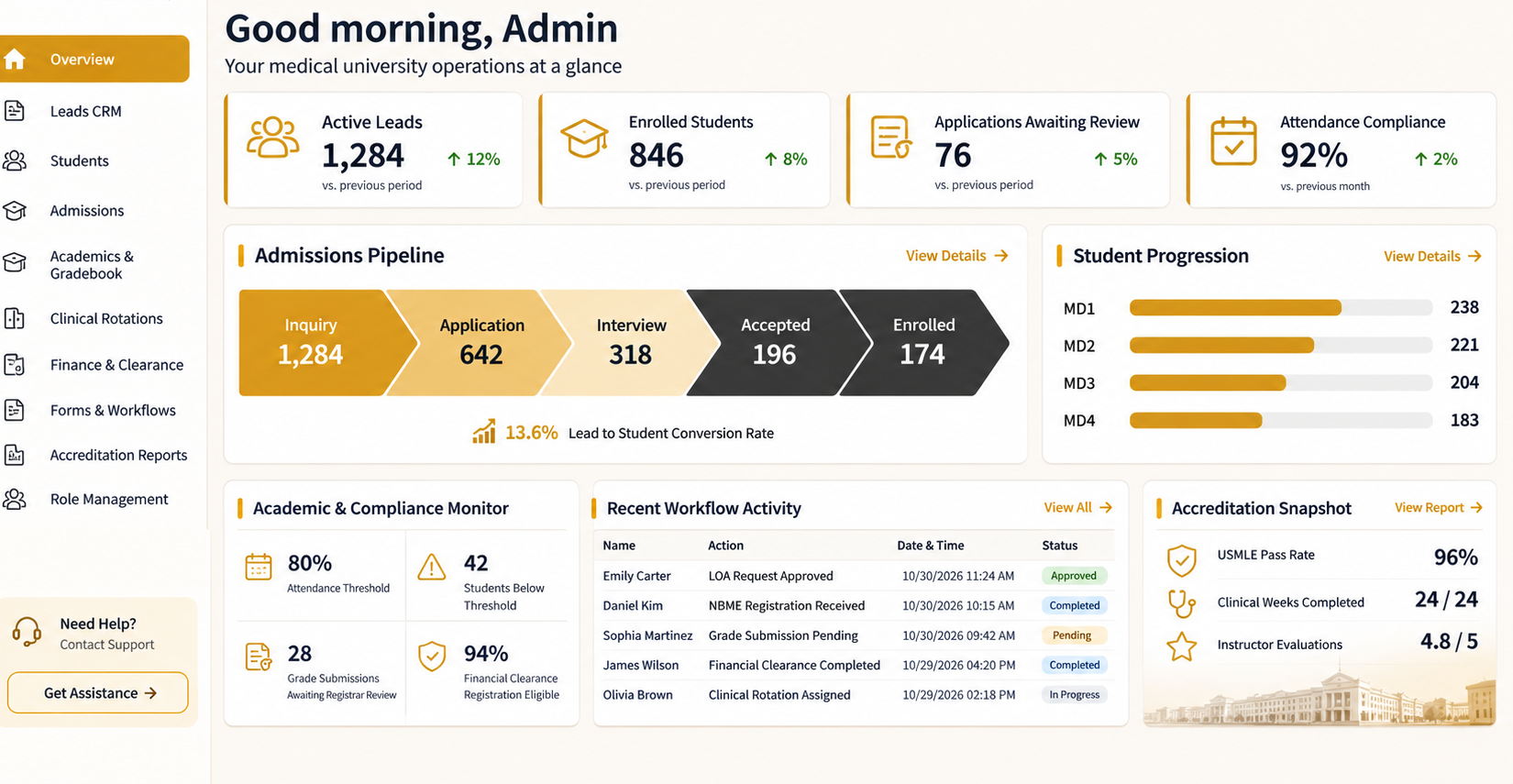
- Census, USMLE pass rates, clinical weeks completed and instructor performance generated from live data.
- Survey and evaluation data turned into histograms and pie charts automatically; legacy modules archived as read-only, searchable tables.
Real-time visibility for leadership
university-dashboard.png
What changed, at a glance
Integrity, efficiency and control at every level
Data integrity across the full lifecycle
Separating Leads from Students eliminated dead records and gave Admissions and the Registrar a database they can trust.
Server-side timestamps, hard-locked grades and a full audit trail make every record traceable and tamper-proof.
Operational efficiency at every level
The Financial Gatekeeper, Auto-Progression Engine, LOA workflow and NBME form removed the largest manual bottlenecks.
Grades are now calculated, standardized and published through a defined approval chain, eliminating grading disputes.
Security and role clarity
Every user sees exactly what they should and nothing more.
The Orange Checkmark override lets the Super Admin re-open submitted forms independently, removing a recurring category of support requests.
Accreditation-ready reporting
Leadership sees USMLE pass rates, clinical completion, census data and instructor performance on one dashboard, with no spreadsheet consolidation.
Charts from survey and evaluation data are generated automatically before every deadline.
Software that reflects how the university actually works, instead of forcing people to adapt to generic tools.
By building on Kodefast, the university replaced a fragmented, outdated system with a unified operational backbone. Policies are now enforced through intelligent workflows, from financial clearance and registration controls to attendance monitoring, compliance tracking, grading and document management. Processes that once depended on manual intervention are automated, governed and auditable, giving the institution a modern, scalable system built around its own requirements.