
A national network squeezed into a flat, rigid CRM
The client is one of India's largest education and test-preparation networks, operating a massive web of franchises and regional offices across the country. They were using a rigid third-party CRM to manage both walk-in inquiries and digital leads.
That platform could not mirror their complex physical hierarchy or provide the granular control needed at their scale. Its closed architecture also blocked them from integrating their own custom-built internal tools or applying their own lead prioritization logic.
The organization needed a custom, API-first, role-based CRM capable of managing the entire lead lifecycle while serving as a flexible hub for an evolving tech stack.
The software had to bend to the institute's workflow, not the other way around.
Five gaps between the CRM and the way the network really runs
Workflow rigidity and disconnected calls
- The previous system forced leads into a generic process that didn't match the institute's reality.
- Counselors dialled numbers manually on separate phones, leaving no digital record of conversations or outcomes.
- Automation was too limited for complex edge cases, so staff relied on manual workarounds that slowed operations.
Hierarchy mismatch
- The tool treated the organization as a flat structure, failing to distinguish between Franchise Owners, Center Teams and Regional Offices.
- Data visibility couldn't be mapped to the physical hierarchy, raising privacy concerns between franchises.
- Regional managers aggregated data from multiple centers in error-prone spreadsheets, delaying reports.
Inability to integrate internal tools
- The client's own development team built custom tools, but the legacy system was a walled garden that blocked connections.
- Internal innovations couldn't be leveraged, and interaction data stayed trapped in siloed apps with no 360-degree view of the student journey.
Lack of scientific prioritization
- Every lead was treated equally, with no intelligent way to identify hot prospects.
- The client had its own behavior-based scoring approach, but the software forced generic, irrelevant models, so high-value leads went cold.
Security and agency risk
- External marketing agencies needed performance data, but couldn't be given safe access.
- All-or-nothing permissions risked exposing sensitive student PII, making partner data sharing a binary risk.
An owned, hierarchy-aware lead platform, built at no-code speed
Every lead, anchored to the right place in the network
A master data backbone models the physical hierarchy so ownership, visibility and reporting all follow the real organization.
Agile no-code development
- A fully customized enterprise solution built and deployed rapidly on Kodefast's no-code platform.
- Complex features iterated in days rather than months, with no heavy technical debt as the business scales.
Master data backbone
- A single source of truth that digitally models State › City › Franchise.
- Every lead anchored to the correct operational node, with reporting that rolls up from center to regional to national level.
Advanced universal rule engine
- Handles high-complexity rule permutations and deep conditional nesting, including edge cases not yet identified.
- Automated lead routing by counselor load, student location and course interest.
Seamless click-to-call
- The client's own choice of telephony app integrated into the CRM, instead of a forced vendor.
- One-click calls from the dashboard, each recorded and logged against the lead for context and quality monitoring.
Custom client-centric scoring
- A scoring model that mirrors the institute's own business intuition and market knowledge.
- Counselors focus on the leads with the highest probability of conversion.
Open API and unified ecosystem
- A standardized API event bus lets different systems trigger actions across the network.
- In-house tools plug and play, turning the CRM into a universal connector that scales as new tools arrive.
Granular role-based access
- Super Admin, Center Director and Counsellor roles enforce visibility by physical hierarchy.
- A dedicated Collaborator role gives agencies campaign stats while fully masking student PII.
Immutable audit trail
- Every action, timestamp and permission change logged as a forensic record.
- Every status change or data export traceable to a specific user, giving auditors a verifiable compliance footprint.
A single pane of glass for the whole network
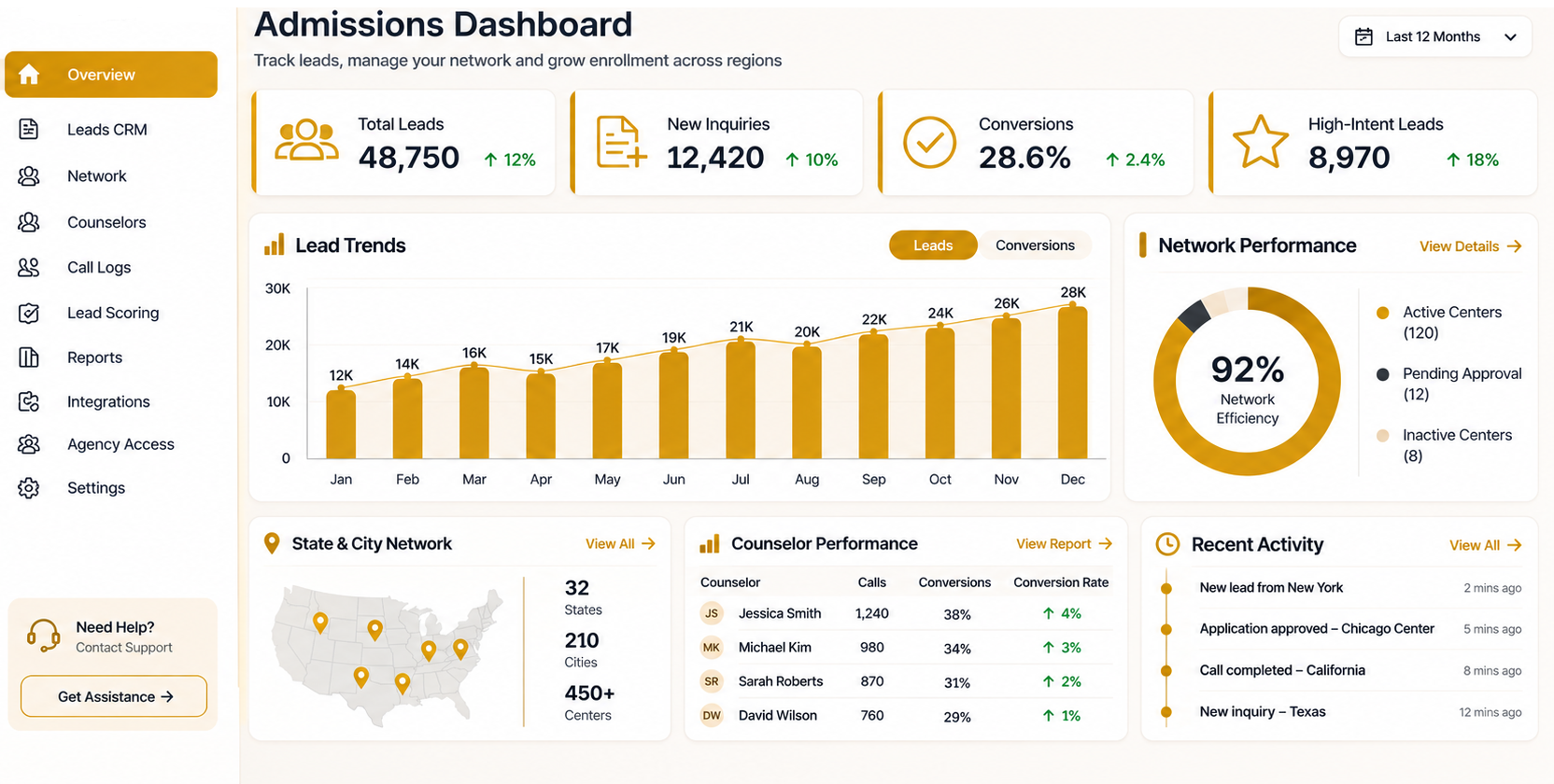
pan-india-dashboard.png
What changed, at a glance
More control, faster sales, lower cost
100% process optimization
A rigid, fragmented process became a flexible, hierarchy-aware workflow that mirrors the business.
Automation absorbs unique rules and operational shifts without code changes, and manual entry errors are gone.
Enhanced sales velocity
Integrated calling removed manual dialling and raised daily touchpoints per counselor.
Scientific prioritization and faster lead response improved conversion for competitive courses.
Cost reduction via tech independence
In-house tools now run inside the workflow, reducing reliance on expensive third-party vendors.
Owned infrastructure replaced rigid licenses, lowering total cost of ownership and removing subscription and custom development fees.
Total funnel visibility
Leadership has real-time reporting filtered by franchise, city or course for faster strategic decisions.
Regional managers got back hours each week once manual report consolidation disappeared.
Security and external collaboration
Agencies optimize campaigns on real-time data without seeing student PII, thanks to strict RBAC and data isolation.
A verifiable compliance footprint builds trust with premium marketing partners.
Operational complexity, turned into a strategic advantage.
On Kodefast's adaptable no-code platform, the institute moved from a rigid legacy provider to a unified operational backbone that captures its unique way of working. Integrating the client's chosen calling app and a custom scoring engine changed how counselors prioritize and engage students, while an open architecture and an advanced rule engine brought in-house tools and complex rules under one roof. The result is a system that is efficient, secure and cost-effective, ready to support continued growth across the country.